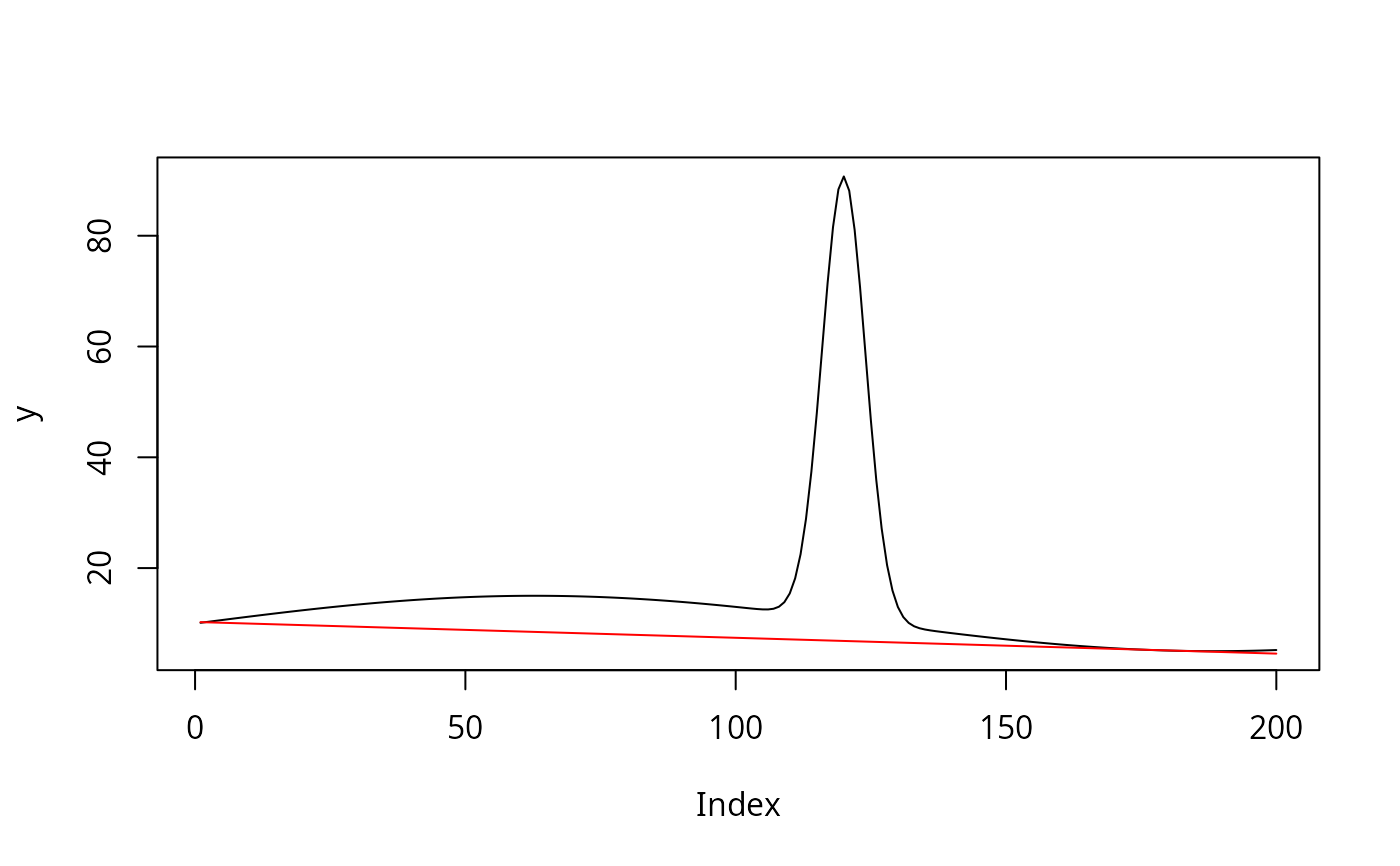
Estimates the baseline of one or more spectra using the PSALSA (Peaked Signal's Asymmetric Least Squares Algorithm) method. PSALSA is a variant of asymmetric least squares that limits the influence of intense peaks on the estimated baseline, which improves the result for signals containing sharp, high peaks.
Arguments
- spectra
Either a numeric vector containing one spectrum, or a matrix containing one spectrum per row.
- lambda
Smoothing parameter (generally
1e5-1e8).- p
Asymmetry parameter.
- k
Peak height parameter, controlling how strongly the weights of points above the baseline decay with their height. Usually about 5% of the maximum intensity. When
k = -1(the default) it is set to one twentieth of the maximum intensity of each spectrum.- maxit
Maximum number of iterations.
- k_epsilon
Floors
katk_epsilon * diff(range(spectra)), so an estimated or suppliedkthat is (near) zero can't make the asymmetric weightexp(-d/k)collapse to 0 for essentially any positive residual – which happens for a genuinely near-noise-free signal, sincekis usually derived from an estimated noise level (seetune_psalsa()), silently degenerating the baseline toward the signal's minimum. Scaled by the data's own range (rather than a fixed absolute value) so the floor stays proportionate regardless of the signal's amplitude.
Value
A list with two elements, each with the same dimensions as
spectra:
baselinethe estimated baseline.
correctedthe baseline-corrected signal, i.e.
spectra - baseline.
Details
Like ordinary asymmetric least squares, PSALSA assigns different weights to
the points above and below an iteratively estimated baseline: the asymmetry
parameter p (0 <= p <= 1) is the weight for points below the baseline,
whereas points above it normally receive weight 1 - p. The difference is
that for points above the baseline the weight decays exponentially with the
height of the point above the current estimate, controlled by k. This
prevents intense peaks from pulling the baseline upwards. The parameter
lambda controls the amount of smoothing: the larger it is, the smoother
the baseline will be. Iteration stops once the set of points above the
baseline no longer changes, or after maxit iterations.
The baseline is fitted with a weighted second-order Whittaker smoother.
References
Oller-Moreno, S., Pardo, A., Jimenez-Soto, J. M., Samitier, J., Marco, S. (2014). "Adaptive Asymmetric Least Squares baseline estimation for analytical instruments". 2014 IEEE 11th International Multi-Conference on Systems, Signals & Devices (SSD14), 1-5. doi:10.1109/SSD.2014.6808837