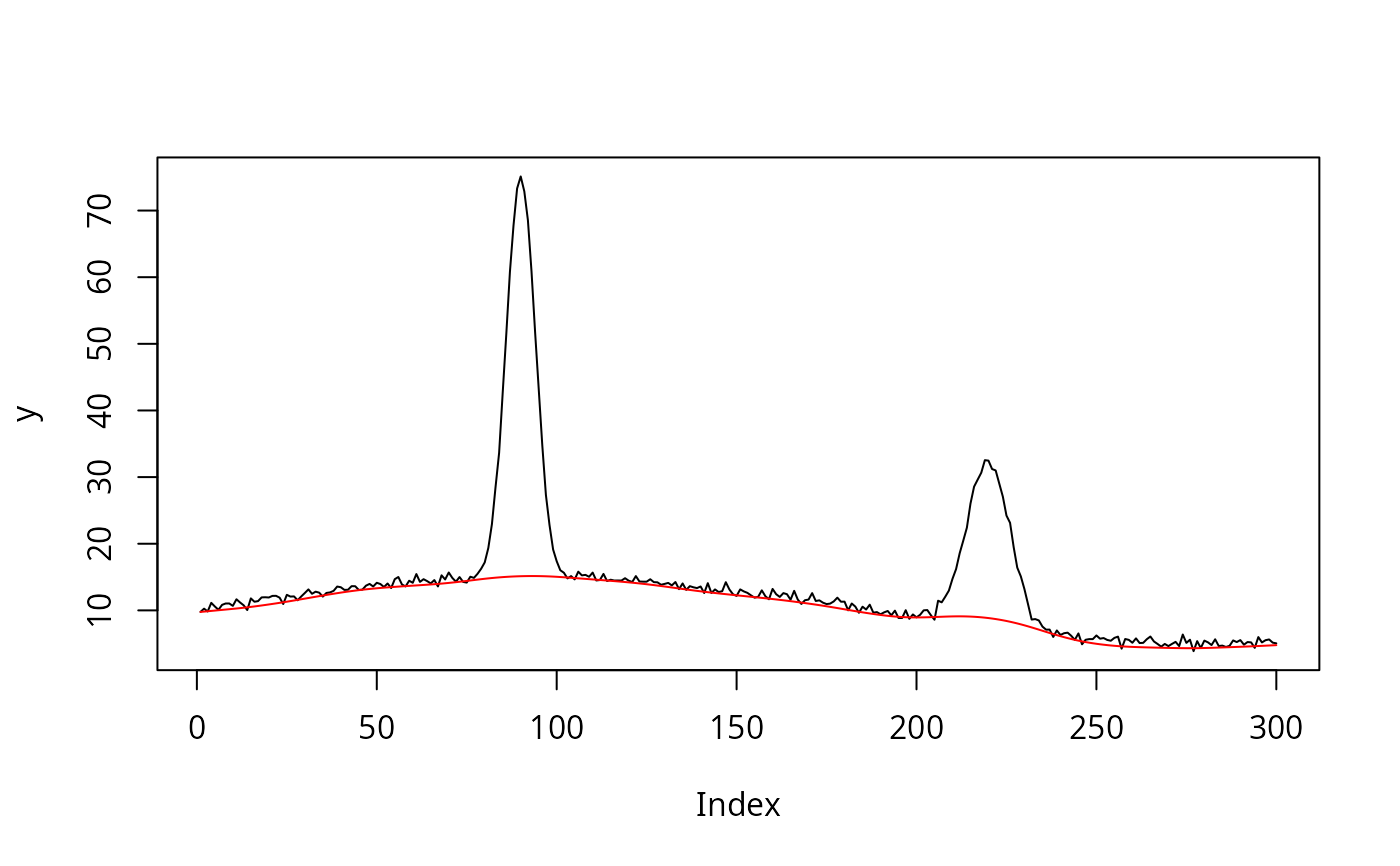
psalsa() needs lambda, p and k to be chosen for the data at hand, and
good values depend on the signal's noise level, peak width and peak density.
tune_psalsa() picks them automatically from example spectra, without
requiring a known baseline: it analyzes the noise level and a rough peak
width/density summary of y, generates a batch of synthetic spectra with
matching characteristics (for which the true baseline and peak areas are
known by construction, since they were generated), and searches for the
lambda/p/k that best recovers those synthetic peaks' areas. The
resulting parameters are then applied to y to produce the returned
baseline.
Usage
tune_psalsa(
  y,
  peak_shape = c("gaussian", "gex"),
  n_synthetic = 10,
  optim_maxit = 150,
  optim_reltol = 1e-06
)
Arguments
- y
A numeric vector with one example spectrum, or a list of numeric vectors with several example spectra (their characteristics are pooled together before tuning). Lists of differing lengths are supported.
- peak_shape
Either
"gaussian"or"gex"(an asymmetric, exponentially-modified peak shape typical of chromatography). Peak shape is often known from the instrument/technique used to acquirey, so it is left as an explicit argument rather than inferred from the data.- n_synthetic
Number of synthetic spectra generated for the search.
- optim_maxit
Maximum number of
stats::optim()(Nelder-Mead) iterations.- optim_reltol
stats::optim()relative convergence tolerance.
Value
If y is a single numeric vector, a list with:
baseline,correctedas in
psalsa(), forywith the tuned parameters.lambda,p,kthe tuned parameters, reusable via
psalsa(other_y, lambda = lambda, p = p, k = k)on similar spectra without tuning again.
If y is a list, baseline and corrected are lists (one element per
input spectrum, using the same tuned lambda/p/k for all of them).
Details
The search balances recovery across small, medium and large peaks (by true area) so that a few large peaks don't dominate the objective at the expense of small ones; it falls back to a plain baseline-accuracy objective when the synthetic batch doesn't contain enough well-separated peaks to define those three groups (e.g. very dense or very wide peaks, which tend to overlap).
See also
psalsa(), the function being tuned.